Discover what WAT means in text, how to use it in chats, and see examples of this popular slang term in everyday conversations.
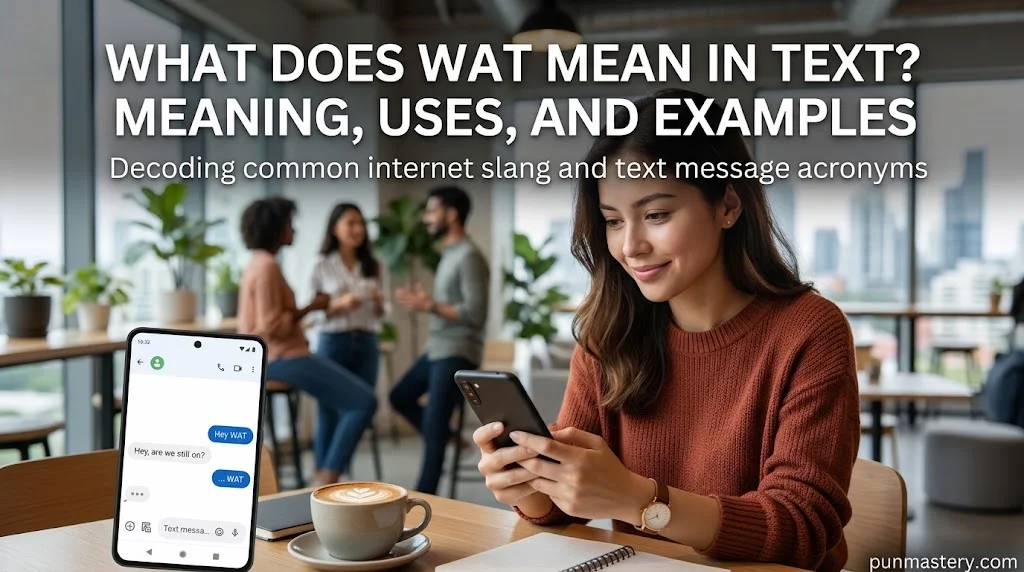
Have you ever received a message containing WAT and wondered what it means? In texting, WAT is an informal spelling of “what,” often used in casual conversations, online chats, and social media. The abbreviation WAT is commonly used in text messages when someone wants to ask a question, express confusion, or show surprise. It has the same basic meaning as “what” but uses fewer letters, making it quick and easy to type. You might see it in conversations with friends, family members, or online gaming partners. Understanding what WAT means in text can help you interpret messages more accurately and avoid confusion. Although it is popular in informal communication, it is generally better to use standard spelling in professional emails or formal conversations.
The meaning of WAT in texting can also depend on the conversation’s tone and context. For example, someone might write “WAT happened?” to ask what occurred or “WAT? Seriously?” to express disbelief. In some situations, it can sound playful, while in others, it may communicate genuine confusion or surprise. People commonly use this spelling on platforms such as Snapchat, Instagram, TikTok, and WhatsApp. However, WAT is not always a separate acronym with a fixed meaning; it often represents a casual variation of “what.” Learning how it is used in different situations can help you understand online slang and respond naturally to messages.
What Does WAT Mean in Text?
WAT means “what” in text messages and online conversations. It’s an informal spelling that people often use to express confusion, surprise, disbelief, or curiosity. Instead of typing the standard spelling, they write WAT to make their reaction sound casual, playful, or exaggerated.
For example, imagine your friend texts you, “I accidentally wore two different shoes to work.” You might respond, “WAT 😂” to show that you’re surprised and amused.
The word itself doesn’t have a completely different definition from “what.” Instead, the unusual spelling adds personality to the message. It can make a reaction feel more spontaneous or humorous, especially when someone shares unexpected information.
People commonly use WAT in these situations:
- Confusion: When they don’t understand something.
- Surprise: When they hear unexpected news.
- Disbelief: When something sounds unbelievable.
- Curiosity: When they want someone to explain more.
- Humor: When they react playfully to an unusual situation.
The tone depends on the context. A message such as “WAT happened?” sounds like a request for information, while “WAT?! 😂” usually expresses a stronger, more emotional reaction.
What Does WAT Stand For?
In everyday texting, WAT generally represents an informal spelling of the English word “what.” It isn’t usually an acronym in which each letter stands for a separate word.
People sometimes use alternative spellings online because they want their messages to feel expressive, relaxed, or funny. WAT follows this pattern. Its spelling can make a reaction seem exaggerated, similar to saying “Whaaat?” aloud when something surprises you.
Consider these examples:
- Standard: “What are you talking about?”
- Informal: “WAT are you talking about?”
- Playful: “WAT is going on here 😂”
- Surprised: “WAT?! That actually happened?”
All four examples communicate a similar basic question. However, the informal spelling may create a more playful or exaggerated tone.
It’s also important to remember that WAT can have other meanings in specialized settings. A technical discussion, organization, game, or professional community might use the same letters as an abbreviation for something specific.
Therefore, don’t assume that every appearance of WAT means “what.” Read the surrounding words first. In ordinary conversations, though, the informal spelling is the most likely interpretation.
How Is WAT Used in Text Messages?
WAT is flexible because people can use it to communicate several reactions without writing a complete sentence. The same three letters can express confusion, shock, amusement, or a simple request for clarification.
WAT to Express Confusion
One of the most common uses of WAT is to show that a message doesn’t make sense to the reader.
For example:
Friend: “I’ll meet you at the usual place, but not the usual location.”
You: “WAT? Where are we meeting?”
Here, WAT tells the other person that their message is confusing. It encourages them to explain what they mean.
You might also use it when someone gives unclear instructions, changes plans unexpectedly, or shares information that seems contradictory.
Examples include:
- “WAT does that even mean?”
- “WAT are you trying to say?”
- “WAT? I thought we agreed on Friday.”
- “WAT is happening right now?”
Although WAT can communicate confusion quickly, a complete question is often more useful when the other person needs specific information.
WAT to Show Surprise
Sometimes, WAT is less about confusion and more about reacting to unexpected news.
Imagine your friend tells you that they won a free vacation. You might respond, “WAT?! That’s amazing!”
In this situation, you understand what your friend said. You’re simply surprised by the information.
Common examples include:
- “WAT?! You got the job?”
- “WAT, you’re moving to another state?”
- “WAT?! We actually won?”
- “WAT 😂 I wasn’t expecting that.”
Punctuation and emojis help communicate the emotion behind the message. Multiple question marks or an exclamation point often suggest a stronger reaction.
WAT to Express Disbelief
WAT can also communicate that something sounds difficult to believe. This use is common when someone shares an unusual story, a surprising result, or an unexpected claim.
For example:
Friend: “My little brother finished the entire pizza by himself.”
You: “WAT?! The whole pizza?”
Your response suggests that you’re amazed by what happened. You might believe your friend, but the story still seems surprising.
Other examples include:
- “WAT?! That can’t be real.”
- “WAT, you did all that in one day?”
- “WAT?! How did that happen?”
- “WAT 😂 No way!”
Be careful with tone, though. In a serious conversation, a message like “WAT?!” may sound dismissive if the other person expects a thoughtful response.
WAT to Ask for Clarification
WAT doesn’t always express a strong emotion. Sometimes, it simply asks someone to explain a statement.
For example:
Friend: “Let’s do the thing we discussed yesterday.”
You: “WAT thing? I forgot.”
Here, WAT introduces a direct request for clarification.
You can use it when you don’t remember a detail, can’t follow someone’s explanation, or need more information before responding.
Examples include:
- “WAT time should I come?”
- “WAT do you mean by that?”
- “WAT happened after I left?”
- “WAT are the instructions again?”
For clearer communication, especially with people you don’t know well, write the complete question rather than relying on WAT alone.
WAT as a Playful or Funny Reaction
Online conversations often move quickly. A short reaction can communicate an entire mood, and WAT works well when someone wants to respond without writing a long explanation.
For example, your friend might send you a picture of an enormous sandwich. You could reply, “WAT is that thing? 😂”
The message sounds amused rather than genuinely confused.
People also use WAT in memes, funny videos, gaming moments, and conversations about bizarre situations.
Examples include:
- “WAT did I just watch? 😭”
- “WAT is this masterpiece?”
- “WAT kind of plot twist was that?”
- “WAT 😂 My brain needs a minute.”
In these examples, WAT adds dramatic emphasis. The humor often comes from the unexpected situation rather than the word itself.
WAT Meaning in Different Contexts
Although WAT generally means “what,” the platform and surrounding conversation can influence how people interpret it. The following examples explain how it commonly appears online.
WAT Meaning in Chat and Texting
In everyday text messages, WAT usually works as an informal replacement for “what.” Friends might use it when they don’t understand a message or want to react dramatically to unexpected news.
For example:
Person A: “I accidentally sent the message to the wrong group chat.”
Person B: “WAT 😭 What did you send?”
The response combines surprise with curiosity. The second question asks for details, while the initial WAT shows an immediate emotional reaction.
In texting, spelling, punctuation, emojis, and previous messages all contribute to meaning. That’s why you shouldn’t interpret WAT in isolation when the conversation provides additional clues.
WAT Meaning on Snapchat
On Snapchat, WAT may appear in private chats, reactions to snaps, or conversations with friends. Its basic meaning remains the same: an informal version of “what.”
For example, someone might send a snap showing an unexpected haircut. Their friend could reply, “WAT happened to your hair 😂”
The sender isn’t necessarily criticizing the haircut. Depending on their relationship and the accompanying emoji, the message could be playful teasing or genuine surprise.
If someone sends you WAT on Snapchat, consider what you shared immediately before receiving the message. That context will usually help you understand their reaction.
WAT Meaning on Instagram, TikTok, and Facebook
On Instagram, TikTok, and Facebook, WAT can appear in comments, direct messages, replies, and discussions about videos or posts.
People often use short expressions when reacting to content that surprises them. For example, a viewer might comment “WAT did I just watch?” under a strange or unexpected video.
Here are a few examples:
- Instagram: “WAT is happening in this Reel?”
- TikTok: “WAT 😂 That ending was wild.”
- Facebook: “WAT?! I didn’t know they were getting married.”
- Direct messages: “WAT did you mean in your last message?”
These are illustrative examples, not official definitions specific to each platform. WAT doesn’t have a separate universal meaning on Instagram, TikTok, or Facebook.
WAT Meaning in Gaming Chats
Gaming conversations often involve quick reactions to sudden events, unexpected defeats, unusual glitches, or surprising moves. WAT fits naturally into these fast-paced exchanges.
For example, imagine you’re playing an online game with friends. Your character suddenly loses a match despite having a clear advantage.
You might type, “WAT just happened?”
Other common examples include:
- “WAT was that move?”
- “WAT?! How did you survive?”
- “WAT happened to our team?”
- “WAT is this glitch?”
In gaming, WAT can express frustration as well as surprise or confusion. The player’s previous messages and the situation help determine which emotion is most likely.
WAT Meaning in Online Communities
Informal spellings such as WAT also appear in forums, memes, group chats, and other internet communities. Members may use them to create a recognizable, exaggerated reaction.
For example, someone might share a bizarre hypothetical question in a discussion group. Another member could respond, “WAT did I just read?”
This type of response communicates disbelief while keeping the interaction light.
However, individual communities sometimes develop their own abbreviations. If WAT appears in a technical discussion or a specialized group, check whether the surrounding conversation suggests a different meaning.
WAT Texting Examples With Meanings
Examples make texting slang easier to understand because they show how a word functions in a real conversation. Below are common ways someone might use WAT.
| Texting example | Likely meaning |
| “WAT? I don’t understand.” | Confusion |
| “WAT?! You won the lottery?” | Surprise |
| “WAT 😂 That’s hilarious.” | Amusement |
| “WAT happened last night?” | Asking for information |
| “WAT do you mean?” | Requesting clarification |
| “WAT?! No way!” | Disbelief |
| “WAT is that supposed to be?” | Confusion or criticism, depending on tone |
| “WAT are you doing here?” | Surprise or a direct question |
| “WAT just happened to my game?” | Confusion or frustration |
| “WAT 😭 I can’t stop laughing.” | Amused disbelief |
These meanings are contextual rather than fixed. The same message may sound friendly between close friends but abrupt between people who don’t know each other well.
More WAT Examples in Everyday Conversations
Example: Unexpected news
Person A: “I’m leaving for New York tomorrow.”
Person B: “WAT?! Since when?”
Meaning: Person B is surprised and wants more information.
Example: Confusing instructions
Person A: “Bring the blue folder, but leave the blue one at home.”
Person B: “WAT? Which folder do you need?”
Meaning: Person B needs clarification because the instructions conflict.
Example: Funny situation
Person A: “My cat knocked over the plant and then sat inside the pot.”
Person B: “WAT 😂 Your cat is something else.”
Meaning: Person B is amused by the unusual story.
Example: Gaming reaction
Person A: “I defeated the final boss with one health point left.”
Person B: “WAT?! How did you pull that off?”
Meaning: Person B expresses amazement and curiosity.
Example: Misunderstood message
Person A: “I said we should meet after lunch.”
Person B: “WAT? I thought you said before lunch.”
Meaning: Person B is confused about the original plan.
How to Reply When Someone Texts WAT
Your response should match the situation. If the sender is confused, explain your message. If they’re surprised, provide more details. If they’re joking, a playful response may be enough.
Reply When They’re Confused
When someone types WAT because they don’t understand you, focus on making your message clearer.
Examples:
- “Sorry, I meant we’re meeting at 6.”
- “Let me explain that another way.”
- “I meant the other location.”
- “Here’s what I was trying to say.”
Tip: Don’t repeat the same confusing sentence. Use simpler words or provide a specific example.
Reply When They’re Surprised
If the person reacts to unexpected news, acknowledge their surprise and share the relevant details.
Examples:
- “I know, right? I didn’t expect it either.”
- “Yep, it really happened!”
- “I’ll explain everything when we talk.”
- “Surprise! I wanted to tell you in person.”
A friendly reply helps keep the conversation moving without making the other person feel silly for reacting strongly.
Reply When They’re Joking
If WAT appears alongside laughing emojis or a funny comment, you can respond with humor.
Examples:
- “Don’t ask me. I have questions too 😂”
- “Even I’m confused.”
- “The situation got out of hand.”
- “I wish I had an explanation.”
You don’t need to overthink every slang message. When the conversation is clearly playful, a short and natural response usually works best.
Reply When You Don’t Understand Their Reaction
Sometimes, you won’t know whether WAT expresses surprise, confusion, or annoyance. Instead of guessing, ask a simple question.
Examples:
- “What part confused you?”
- “Wait, what do you mean?”
- “Did I explain that badly?”
- “Are you surprised or did I miss something?”
These replies are particularly useful when the topic matters or you want to avoid a misunderstanding.
Is WAT Rude or Disrespectful?
WAT isn’t inherently rude. Most of the time, it functions as an informal expression of confusion, surprise, or disbelief. However, its tone depends on the relationship between the people texting and the situation.
For example, replying “WAT 😂” to a close friend may seem completely normal. Sending “WAT?!” to a manager after receiving an instruction could sound impatient or dismissive.
Consider these differences:
| Message | Possible interpretation |
| “WAT 😂” | Playful surprise |
| “WAT?” | Confusion or a request for clarification |
| “WAT?!” | Strong surprise or disbelief |
| “WAT is wrong with you?” | Potentially confrontational |
| “What do you mean?” | Direct request for clarification |
| “Could you explain that?” | Polite request for more information |
These interpretations aren’t universal. Some people use WAT casually in almost every conversation, while others may find it abrupt.
If you’re communicating in a professional setting, use standard spelling and complete questions. In a friendly conversation, WAT is usually fine when it matches the tone.
Difference Between WAT, WHAT, WTF, and WTH
WAT, WHAT, WTF, and WTH may appear in similar situations, but they differ in spelling, tone, and intensity.
| Term | Meaning | Common tone |
| WAT | Informal spelling of “what” | Casual, playful, or surprised |
| WHAT | Standard English word | Neutral, curious, surprised, or confused |
| WTF | “What the f***” | Strong surprise, frustration, or disbelief; vulgar |
| WTH | “What the heck” or “what the hell” | Surprise, confusion, or frustration |
WAT vs. WHAT
The primary difference is spelling. WHAT is the standard English word, while WAT is an informal alternative used in casual digital communication.
For example:
- WHAT: “What happened yesterday?”
- WAT: “WAT happened yesterday?”
Both ask about an event. The second version may sound more playful or exaggerated, depending on the conversation.
WAT vs. WTF
WTF stands for “what the f***,” a vulgar expression people often use to communicate shock, anger, or disbelief.
For example:
- “WAT?! That’s unexpected.”
- “WTF?! That’s unbelievable.”
Both messages can express surprise, but WTF usually carries stronger language and may be inappropriate in professional or family settings.
WAT offers a less vulgar alternative when you want to express surprise without using profanity.
WAT vs. WTH
WTH commonly stands for “what the heck” or “what the hell.” The intended expansion depends on the person using it.
For example:
- “WAT is happening?”
- “WTH is happening?”
Both can express confusion. However, WTH adds an extra expression of frustration or surprise and may sound more emphatic.
If you want to keep your message simple and casual, WAT may be sufficient.
When Should You Use WAT?
WAT works best when you want a quick, informal reaction. It can make a conversation feel spontaneous without requiring a complete sentence.
Consider using WAT in these situations:
- Casual conversations: When messaging friends or family members who understand your texting style.
- Unexpected news: When someone tells you something surprising.
- Funny situations: When reacting to a joke, meme, or unusual story.
- Gaming chats: When responding quickly to an unexpected event.
- Social media comments: When a post leaves you confused or amazed.
- Requests for clarification: When you want someone to explain something, provided the casual tone fits.
For example, if your friend texts, “I just met my favorite actor at the grocery store,” you could reply, “WAT?! Seriously?”
The message sounds natural because it matches the excitement of the news.
However, consider your audience. Slang works best when both people understand its meaning and tone.
When Should You Avoid Using WAT?
Although WAT is common in casual online communication, it isn’t ideal for every situation. Informal spelling can sometimes make a message look careless or sound more abrupt than intended.
Avoid using it when:
- Writing professional emails: Use standard spelling and clear questions.
- Communicating with clients: Choose polite language that avoids unnecessary ambiguity.
- Discussing sensitive topics: A strong reaction could make someone feel dismissed.
- Giving formal instructions: Complete sentences reduce the risk of confusion.
- Messaging unfamiliar people: They may not recognize your intended tone.
- Handling disagreements: WAT may sound sarcastic or confrontational in an already tense conversation.
For example, instead of replying “WAT?” to an important work instruction, write, “Could you clarify which document you need?”
The second response is more specific and professional. It also tells the other person exactly what information you need.
Is WAT Still Used in Texting?
WAT remains understandable as an informal spelling of “what” in many online conversations. However, its use varies from person to person, and it shouldn’t be treated as the standard spelling.
Some people prefer WAT because it feels playful or expressive. Others simply type “what?” because it’s clearer and more familiar.
You’ll generally understand the expression when you encounter it in casual messages, memes, online discussions, or gaming conversations.
There isn’t a single reliable usage figure that establishes how frequently everyone uses WAT across all platforms. Its popularity can vary by community, age group, and personal texting habits.
The practical takeaway is simple: WAT is an informal option, not a separate word you need to use in every conversation. If you understand the context, you can usually interpret it without difficulty.
Common Mistakes to Avoid When Interpreting WAT
Even a short expression can cause confusion when readers assume too much about the sender’s intentions.
Keep these points in mind:
- Don’t automatically assume anger. WAT can express surprise or amusement rather than irritation.
- Don’t assume romantic interest. Someone using WAT is usually just reacting to your message. The word alone doesn’t reveal attraction.
- Don’t treat every use as an acronym. In ordinary texting, it generally represents “what.”
- Don’t ignore punctuation. “WAT?” and “WAT?!” may communicate different levels of surprise.
- Don’t overlook emojis. A laughing emoji may signal humor, while the same words without an emoji could sound more serious.
- Don’t rely on the word alone. Read the previous messages to understand what prompted the response.
For example, if someone writes “WAT 😭” after you share a funny story, they may be laughing rather than expressing distress. In informal online communication, the crying emoji often represents intense laughter, although context still matters.
The best approach is to interpret WAT alongside the entire conversation instead of assigning it one fixed emotional meaning.
FAQs
What Is the Difference Between WAT and WTF?
WAT is an informal spelling of “what,” while WTF stands for “what the f***.” Both can express surprise or disbelief, but WTF includes profanity and often sounds stronger. WAT is generally more suitable when you want a casual reaction without vulgar language.
Can WAT Be Used in Professional Messages?
It’s generally better to avoid WAT in formal emails, client messages, and workplace communication. Although people may understand it, the spelling can sound overly casual or abrupt. Instead, write “What do you mean?” or “Could you please clarify?” These alternatives communicate your question more clearly.
What Does WAT Mean in Gaming?
In gaming chats, WAT usually expresses surprise, confusion, or disbelief about something happening in the game. For example, “WAT just happened?” might be a player’s reaction to an unexpected defeat, unusual move, or surprising outcome.
Does WAT Always Mean Someone Is Confused?
No. WAT can express confusion, but it can also show surprise, amusement, disbelief, or curiosity. The surrounding conversation, punctuation, and emojis help determine the intended meaning.
Should You Reply When Someone Texts WAT?
You can reply if the message needs clarification or a response. Explain what you meant if the sender seems confused, provide details if they’re surprised, or respond playfully if they’re joking. If their intention isn’t clear, ask what they mean rather than assuming they’re upset.
Conclusion
WAT usually means “what” in text messages. People use it as an informal spelling to express confusion, surprise, disbelief, curiosity, or amusement. You’ll often see it in casual conversations, social media comments, gaming chats, and online communities. Its exact tone depends on the situation.
A simple “WAT?” may ask for clarification, while “WAT?! ” can express playful disbelief. Unlike WTF or WTH, WAT doesn’t usually contain profanity or an additional expression. When you encounter WAT in a message, read the surrounding conversation before deciding what the sender means. If the tone remains unclear, ask a quick question. That simple step can prevent misunderstandings and help you keep the conversation friendly.