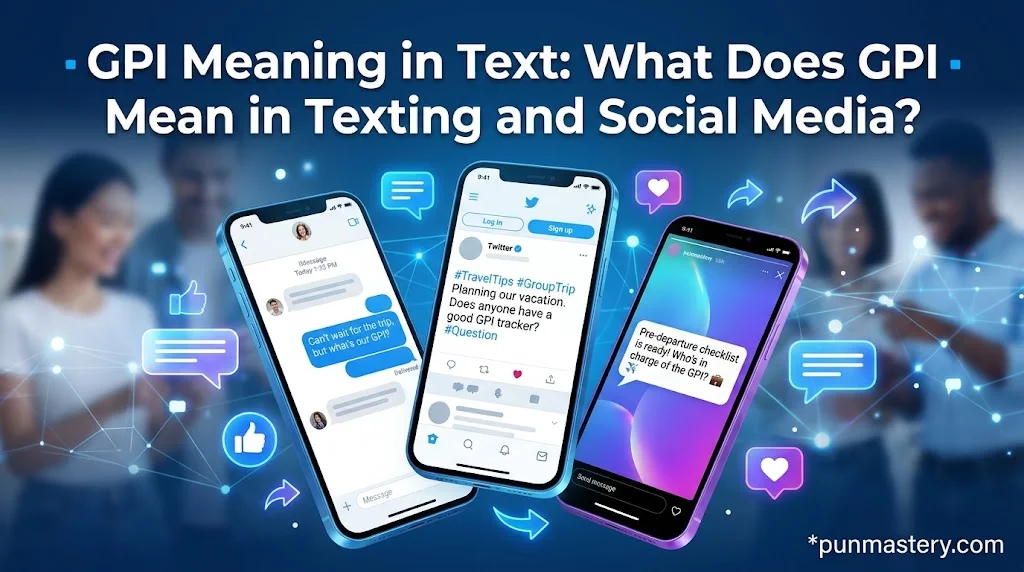
Discover the GPI meaning in text, its Spanish origin, and how people use it on Instagram, TikTok, and WhatsApp with examples and replies.
Have you ever opened Instagram, TikTok, or WhatsApp and noticed someone commenting “GPI” under a picture of friends hanging out? If you haven’t seen this expression before, you might wonder whether it’s a compliment, a joke, or a completely different kind of internet slang. The GPI meaning in text usually comes from the Spanish phrase “Gracias por invitar,” which translates to “Thanks for inviting me” or “Thanks for the invite.” However, there’s a twist. People often use it sarcastically when they discover that friends went somewhere without inviting them.
Imagine your friends posting pictures from a weekend party you didn’t know about. You might comment “GPI ” to jokingly point out that nobody invited you. It’s a short expression that can communicate humor, mild disappointment, or playful frustration without requiring a long message. In this guide, you’ll learn what GPI stands for, how people use it in text messages, what it means on social media, and how to respond when someone sends it to you. You’ll also discover why context matters when interpreting this three-letter expression.
What Does GPI Mean in Text?
In texting and informal online conversations, GPI usually stands for “Gracias por invitar,” a Spanish phrase that means “Thanks for inviting me.” Its common slang use carries an ironic tone because the sender often wasn’t invited in the first place.
People use GPI to react when friends attend a party, visit a restaurant, take a trip, or organize a gathering without including them. Instead of directly asking why they weren’t invited, they make a short, sometimes humorous comment.
For example, imagine that your friends post pictures from a movie night. You weren’t invited, but you discover the gathering through their social media stories. You might reply:
“GPI Looks like you guys had fun!”
In this situation, you’re not genuinely thanking your friends for an invitation. You’re jokingly pointing out that you didn’t receive one.
The expression can carry several meanings depending on the situation:
- Playful teasing: You’re joking with friends about being left out.
- Mild disappointment: You wish someone had included you.
- Sarcasm: You’re pointing out that others made plans without you.
- A request for inclusion: You’re hinting that you’d like an invitation next time.
However, GPI doesn’t always indicate serious frustration. Close friends often use it as a lighthearted joke, especially when they understand each other’s humor.
The key takeaway: When someone writes GPI after seeing pictures of a gathering they missed, they usually mean, “Thanks for inviting me—oh wait, you didn’t!”
What Does GPI Stand For?
GPI comes from the Spanish expression “Gracias por invitar.” Each letter represents the beginning of one word in the phrase.
| Letter | Spanish word | English meaning |
| G | Gracias | Thanks |
| P | Por | For |
| I | Invitar | To invite |
Together, these words express gratitude for an invitation. In casual online conversations, however, the expression often takes on an ironic meaning.
A natural English equivalent would be “Thanks for the invite,” especially when the speaker wants to point out that they weren’t included.
Consider these examples:
- “GPI 😂” — Thanks for the invite, even though nobody invited me.
- “GPI, guys!” — Thanks for leaving me out, everyone.
- “GPI for next time!” — Remember to invite me next time.
- “GPI 😭” — I can’t believe I missed out on that gathering.
The exact interpretation depends on the relationship between the people involved and the circumstances surrounding the message.
For example, a close friend might use GPI to tease someone who went out for coffee without them. Someone who already feels excluded from a social group might use the same expression to communicate genuine disappointment.
Although GPI originates from Spanish, people may encounter it in multilingual online communities where users share slang across languages.
What Does GPI Mean in a Text Message?
When someone sends GPI in a private text message, the surrounding conversation can help you understand their intention.
Unlike expressions with one widely recognized meaning, GPI relies heavily on social context. A message about a party will likely carry a different meaning from a discussion about a technical subject.
Here are several situations in which someone might use GPI.
After discovering a gathering
Your friend sends pictures from a birthday dinner you didn’t attend.
Friend: “Last night was amazing!”
You: “GPI 😂 The food looks delicious.”
Your response playfully suggests that you would have enjoyed receiving an invitation.
When friends make plans without you
You discover that your friends organized a weekend trip without mentioning it to you.
You: “Wait, you guys went to the beach?”
Friend: “Yeah, yesterday!”
You: “GPI 😭 Next time, I’m coming too.”
Here, GPI expresses surprise and a desire to be included next time.
When someone shares exciting news
A friend tells you that the group went to a concert together.
Friend: “We finally saw our favorite band!”
You: “GPI! That must have been awesome.”
This response combines playful disappointment with genuine excitement for your friend.
These examples illustrate how GPI works in casual messaging. The sender uses a few letters to express a feeling that might otherwise require a complete sentence.
However, don’t assume that everyone who uses GPI feels hurt. Sometimes it’s simply a joke between friends.
What Does GPI Mean on Social Media?
Social media gives GPI plenty of opportunities to appear because people regularly share pictures, videos, and updates about their activities.
When someone posts about a gathering, friends who weren’t included may respond with GPI. The comment draws attention to the missing invitation while keeping the conversation informal.
The expression isn’t exclusive to one platform. Its meaning comes from Spanish-language internet slang rather than a special feature of any particular social network.
GPI Meaning on Instagram
On Instagram, GPI may appear in comments, story replies, or direct messages.
Imagine that your friend uploads a carousel of pictures from a restaurant visit. Several mutual friends appear in the photos, but nobody told you about the outing.
You might comment:
“GPI 😂 That place looks amazing!”
The comment jokingly asks why you weren’t invited. It can also signal that you’d enjoy joining the group next time.
Instagram stories create another natural setting for this expression. Because stories often show activities as they happen, someone might discover a gathering through a quick photo or video.
For example:
“Everyone together on a Friday night? GPI 😭”
The meaning is straightforward: the sender noticed the gathering and wishes they had been included.
Still, context matters. If you don’t know the commenter well, avoid assuming that the message is purely humorous. A short reply doesn’t always reveal someone’s real feelings.
GPI Meaning on TikTok
On TikTok, GPI may appear in comment sections, video captions, or messages between users.
For instance, someone might upload a video showing a group of friends enjoying a vacation. A viewer who wasn’t invited could comment:
“GPI 😂 Y’all look like you had the best time!”
The comment expresses playful disappointment while acknowledging that the trip looked enjoyable.
GPI can also appear in videos about friendship, parties, school events, and group activities. In these situations, the phrase helps communicate the feeling of missing out.
However, don’t confuse a platform’s popularity with proof that every user understands the same abbreviation. TikTok includes people from different countries, languages, and age groups. A user who speaks Spanish may recognize GPI immediately, while an English-speaking viewer may need an explanation.
The video’s language, caption, and surrounding comments can help you interpret the phrase correctly.
GPI Meaning on WhatsApp
WhatsApp conversations often involve close friends, family members, and group chats. This makes the platform a natural setting for playful expressions such as GPI.
Suppose your friends organize a dinner and share pictures in a group chat afterward.
You might respond:
“GPI, guys 😂 Save me a seat next time!”
The message lightly calls attention to the missed invitation while keeping the conversation friendly.
In another situation, a family member might post pictures from a weekend outing. You could reply:
“GPI 😭 When are we going together?”
Here, the phrase expresses a desire to join the next outing.
WhatsApp messages also allow users to clarify their intentions quickly. If someone interprets GPI as a serious complaint, a short follow-up can explain that you’re joking.
For example, you might add, “I’m kidding! Hope you had fun.”
Remember: GPI is an informal expression. Use it when the relationship and conversation make its meaning clear.
GPI Meaning on Facebook
Facebook posts, photographs, and group conversations can also provide context for GPI.
For example, a friend might upload photographs from a birthday celebration. Someone who wasn’t invited could comment:
“GPI! Looks like everyone had a great time.”
The comment acts as a playful reminder that the person wasn’t included.
Spanish-language reporting has described GPI as an informal expression used on social media to sarcastically call attention to a missing invitation. The expression can appear in comments, status updates, and private messages.
Its use isn’t limited to Facebook. The same basic meaning applies whenever someone uses the phrase to react to an activity they missed.
How to Use GPI in a Text Message
Using GPI correctly is simple once you understand its meaning and tone. The main consideration is whether the situation calls for a playful remark or a more direct conversation.
Here are practical ways to use it naturally.
Reacting to a party photo
“GPI 😂 The party looks incredible!”
Use this when you want to tease friends about not receiving an invitation.
Responding to vacation pictures
“GPI 😭 You guys went without me?”
This works when you discover that friends took a trip without telling you.
Replying to restaurant stories
“GPI! Next time, I’m picking the restaurant.”
This adds humor while suggesting that you’d like to join a future outing.
Talking in a group chat
“GPI, everyone! At least bring me back some cake.”
This playful response works when you have a comfortable relationship with the people involved.
Hinting that you want to be included
“GPI 😂 Let me know when you plan the next one.”
This version communicates your interest without turning the conversation into a serious confrontation.
However, consider the relationship before using GPI. A close friend may understand the joke immediately, while a coworker or casual acquaintance might interpret it as criticism.
If you genuinely feel excluded, a direct message may be more useful than sarcasm. You could say, “I would have loved to join you. Please let me know next time.”
GPI Meaning in Different Contexts
Although GPI commonly means “Gracias por invitar” in Spanish-language texting, its interpretation depends on the conversation.
Understanding the setting helps you avoid confusing casual slang with an unrelated abbreviation.
In casual conversations: GPI usually refers to being left out of a gathering, trip, meal, or other activity.
In online communities: The expression may spread beyond Spanish-speaking users. However, local communities can develop their own abbreviations, so the letters alone don’t guarantee a particular meaning.
In professional conversations: GPI may refer to a technical, economic, medical, or organizational term rather than texting slang.
For example, the abbreviation can stand for Genuine Progress Indicator in economics. In that context, it refers to a measure designed to assess economic progress while accounting for factors that conventional economic measures may not capture.
In medicine, GPI can also refer to glycosylphosphatidylinositol, a molecule involved in attaching certain proteins to cell membranes.
These meanings have little to do with joking about missed invitations.
| Context | Possible meaning of GPI | How to interpret it |
| Spanish-language texting | Gracias por invitar | Usually a sarcastic or playful comment about not receiving an invitation |
| Social media comments | Gracias por invitar | Often a reaction to a gathering or activity |
| Economics | Genuine Progress Indicator | A measure used to assess aspects of economic progress |
| Medical research | Glycosylphosphatidylinositol | A biochemical term |
| Other professional settings | Context-specific abbreviation | Check the document or subject area |
The important distinction is that an abbreviation doesn’t have one universal meaning in every setting.
If GPI appears beneath a party photo, the Spanish texting interpretation makes sense. If it appears in an economics report, the social media interpretation probably doesn’t.
Examples of GPI in Text Conversations
Examples make internet slang easier to understand because they show how people use expressions in everyday situations.
The following conversations illustrate common ways someone might use GPI to comment on being left out.
Example: Friends at dinner
Alex: “Look at this amazing dinner we had last night!”
Jamie: “GPI 😂 That food looks so good.”
Meaning: Jamie is jokingly pointing out that Alex didn’t invite them.
Example: A birthday party
Mia: “Best birthday ever! 🎂”
Chris: “GPI 😭 I would’ve brought the biggest gift.”
Meaning: Chris is teasing Mia about missing the party.
Example: A weekend trip
Daniel: “We spent the weekend at the lake.”
Sam: “GPI! That place looks beautiful.”
Meaning: Sam wishes they had been included in the trip.
Example: A concert
Taylor: “We finally got tickets to see our favorite band!”
Jordan: “GPI 😂 Next time, count me in.”
Meaning: Jordan is playfully expressing disappointment and interest in attending next time.
Example: A family gathering
Emma: “Sunday lunch with everyone ❤️”
Noah: “GPI! When are we doing another family lunch?”
Meaning: Noah is joking about missing the gathering and suggesting another opportunity.
Example: A group chat
Friend: “We went bowling after work.”
You: “GPI 😅 I didn’t even know there were plans!”
Meaning: You’re pointing out that nobody told you about the outing.
Example: A social media story
Friend posts a video from a beach outing.
You reply: “GPI 😂 Looks like a perfect day.”
Meaning: You’re reacting to the outing with playful sarcasm.
These examples use GPI in plausible conversational situations. They aren’t evidence that every Spanish speaker or social media user uses the expression identically.
How to Reply When Someone Texts You GPI
If someone sends you GPI, your response should reflect the situation. They may be joking, expressing disappointment, or genuinely asking why they weren’t invited.
Start by considering your relationship with the person and the circumstances surrounding the gathering.
If the person is clearly joking
Keep your reply light.
Examples:
- “Next time, you’re definitely coming! 😂”
- “We missed you!”
- “Your invitation must have gotten lost!”
- “You’re in charge of planning the next one.”
- “Don’t worry. We’ll save you a plate.”
These responses maintain the playful tone without making the conversation awkward.
If you accidentally forgot to invite them
Acknowledge the mistake instead of hiding behind humor.
You could say:
- “I’m sorry! We made the plans at the last minute.”
- “You’re right. I should’ve told you.”
- “Sorry you missed out. I’ll make sure to include you next time.”
- “It wasn’t intentional. Let’s plan something together soon.”
A genuine apology works better than a defensive response when someone feels excluded.
If you weren’t responsible for organizing the event
Explain the situation without blaming others unnecessarily.
For example:
“I wasn’t the one organizing it, but I’ll let you know when we plan something together.”
This response acknowledges the message while clarifying your role.
If you’re unsure what they mean
Ask a simple question.
For example:
“Wait, are you joking or did you actually want to come?”
This gives the other person an opportunity to explain how they feel.
The goal isn’t to decode every message perfectly. It’s to respond in a way that keeps communication clear and respectful.
Is GPI an Acronym, Abbreviation, or Slang?
GPI can be described as an initialism used in informal Spanish-language online communication.
An initialism forms a shortened expression from the initial letters of a group of words. People generally read or pronounce the letters individually rather than treating them as one ordinary word.
For example:
- GPI: Gracias por invitar.
- LOL: Laughing out loud.
- BRB: Be right back.
- IDK: I don’t know.
These expressions help people communicate quickly in messages and online conversations.
In everyday discussions, people often use the broader terms abbreviation or texting slang to describe GPI. Those descriptions communicate its practical role, even when a more specific linguistic label is available.
The distinction matters because GPI isn’t a standard English word. Its common slang interpretation comes from a Spanish phrase.
It also isn’t formal Spanish writing. In a professional email, academic paper, or official announcement, spelling out the phrase is generally clearer than relying on informal texting shorthand.
For casual conversations, however, GPI can be an efficient way to express a familiar social reaction.
Is GPI Commonly Used in Texting?
GPI is a recognized expression in Spanish-language internet communication, particularly in contexts where people joke about being left out of social activities.
Spanish-language media have explained its use on platforms such as Facebook, Instagram, TikTok, and WhatsApp. Its meaning is especially clear when someone responds to pictures or updates from a gathering they didn’t attend.
However, it’s important to distinguish recognition within a community from universal popularity.
Not every English-speaking texter knows what GPI means. Some people may recognize it immediately because they speak Spanish or regularly encounter Spanish-language content. Others may mistake it for a technical abbreviation.
Its frequency also varies by region, age group, language, and online community.
For that reason, it’s better to describe GPI as an established piece of informal Spanish-language internet slang than to claim that everyone uses it.
If you’re writing for a mixed-language audience, provide the full phrase and translation when introducing it. Once readers understand the meaning, the examples will make much more sense.
GPI vs. Similar Text Abbreviations
GPI can be confusing when you encounter it alongside other texting abbreviations. Although these expressions all appear in digital communication, they don’t necessarily serve the same purpose.
The following table compares GPI with several widely recognized abbreviations.
| Abbreviation | Full form | Typical use |
| GPI | Gracias por invitar | Sarcastically pointing out that you weren’t invited |
| LOL | Laughing out loud | Expressing laughter or amusement |
| IDK | I don’t know | Showing uncertainty or a lack of information |
| BRB | Be right back | Telling someone you’ll return shortly |
| BTW | By the way | Introducing additional information |
| NVM | Never mind | Withdrawing a question or indicating that something no longer matters |
| TY | Thank you | Expressing gratitude |
The biggest difference is that GPI often communicates a social feeling rather than simply shortening a common English sentence.
For example, LOL typically signals amusement. IDK communicates uncertainty. GPI, by contrast, often hints that the sender noticed an invitation they never received.
This doesn’t mean GPI always expresses disappointment. The sender might use it jokingly or affectionately.
The surrounding conversation determines whether the expression sounds playful, sarcastic, or serious.
Is GPI Rude or Offensive?
GPI isn’t inherently rude or offensive. Its tone depends on the relationship between the sender and recipient, the situation, and the way they normally communicate.
Among close friends, GPI often works as a harmless joke. A friend who sees pictures from a gathering might send the abbreviation simply to tease the group.
However, the same expression can sound critical when someone already feels excluded.
Consider two situations.
In the first, your friends organize an informal coffee outing. You discover the pictures afterward and comment, “GPI 😂.” Everyone understands the joke, and the conversation continues normally.
In the second, you repeatedly find out that your friends have organized events without including you. When you send “GPI 😒,” your message may reflect genuine frustration.
The letters haven’t changed, but the emotional context has.
If you receive GPI, don’t automatically assume that the sender is angry. Likewise, if you use it yourself, remember that the recipient may not recognize your intended humor.
When the relationship matters, clear communication is often better than sarcasm.
How to Tell What GPI Means From Context
If you’re unsure what GPI means in a particular message, examine the surrounding conversation before making assumptions.
A few simple clues can help.
Look at the topic. If the conversation involves a party, trip, dinner, or social gathering, the Spanish slang interpretation may fit.
Check the language. If the sender regularly communicates in Spanish, “Gracias por invitar” is a reasonable interpretation.
Notice the message’s placement. A comment beneath a group photo may carry a different meaning from GPI in a technical report.
Read the surrounding words. A message such as “GPI, next time invite me” strongly suggests the sender is talking about a missed invitation.
Consider the relationship. Close friends often tease each other in ways that strangers might misunderstand.
Ask when necessary. If the abbreviation doesn’t make sense, simply ask what the sender means.
For example, you could reply, “What does GPI mean here?” There’s no need to pretend you understand an abbreviation when you don’t.
Context is especially important in multilingual conversations because the same letters can represent unrelated phrases in different languages and professional fields.
Common Mistakes to Avoid When Using GPI
Although GPI is short, using it appropriately requires a little awareness.
Here are several common mistakes to avoid.
- Assuming everyone understands it: GPI isn’t universally recognized across English-language texting communities.
- Using it in formal communication: A professional email or business report usually calls for clearer wording.
- Treating every message as serious: Friends often use GPI humorously, so consider the context before assuming someone is upset.
- Ignoring genuine disappointment: If someone repeatedly expresses frustration about being excluded, don’t dismiss every message as a joke.
- Confusing it with technical terminology: GPI can have meanings outside texting, including in economics and medicine.
- Assuming the platform determines the meaning: GPI doesn’t have a completely different definition simply because it appears on Instagram rather than WhatsApp.
The best approach is straightforward: understand the phrase, consider the situation, and communicate clearly.
FAQs
What Does GPI Mean in Texting?
GPI usually stands for “Gracias por invitar,” a Spanish phrase meaning “Thanks for inviting me.” People often use it sarcastically when they discover that friends attended a gathering without inviting them. Depending on the context, it can express playful teasing, mild disappointment, or a desire to be included next time.
What Does GPI Mean on Instagram?
On Instagram, GPI commonly refers to “Gracias por invitar.” Someone might comment “GPI 😂” under a picture of friends at a party or restaurant. The comment jokingly points out that the person wasn’t invited. However, the exact interpretation depends on the language and context of the post.
What Does GPI Mean on TikTok?
On TikTok, GPI can carry the same Spanish texting meaning: “Gracias por invitar.” Users may encounter it in comments or conversations about parties, trips, and other group activities. If the video involves a different subject, check the surrounding text before assuming that the phrase refers to a missing invitation.
What Does GPI Mean in Spanish?
In Spanish, GPI represents “Gracias por invitar,” which translates to “Thanks for inviting” or “Thanks for the invite.” In informal online communication, people often use it ironically when someone hasn’t invited them to an event. Its tone can range from playful to genuinely disappointed.
Does GPI Mean Thanks for Inviting Me?
Yes. The common texting interpretation of GPI is “Gracias por invitar,” which means “Thanks for inviting me” in natural English. The important detail is that people frequently use it sarcastically when they weren’t invited. The surrounding conversation helps determine whether the sender is joking or expressing real frustration.
Is GPI a Formal or Informal Expression?
GPI is an informal expression associated with Spanish-language electronic communication. It’s suitable for casual messages and social media interactions when the recipient understands the phrase. In professional writing, formal correspondence, or academic work, spelling out the intended meaning is usually clearer.
Can GPI Have More Than One Meaning?
Yes. GPI can represent different terms depending on the language, industry, or subject. In Spanish texting, it commonly means “Gracias por invitar.” In economics, it can refer to the Genuine Progress Indicator. In medicine, it may refer to glycosylphosphatidylinositol. Always use context to identify the intended meaning.
How Should I Reply When Someone Sends Me GPI?
Your response depends on the situation. If the sender is joking, you might reply, “Next time, you’re coming!” If you accidentally forgot to invite them, acknowledge the mistake and apologize. When you’re unsure about their tone, ask a friendly question rather than assuming they’re upset.
Conclusion
Understanding the GPI meaning in text becomes easy once you recognize its Spanish-language origin. The expression usually stands for “Gracias por invitar,” which translates to “Thanks for inviting me.” In casual online conversations, people often use it sarcastically when they discover that friends went somewhere without including them. You’ll most likely encounter GPI in messages, social media comments, and conversations about parties, trips, dinners, or other group activities.
It can express playful teasing, mild disappointment, or a wish to join the next gathering. However, context matters because GPI can represent unrelated terms in professional and technical settings. The next time someone comments “GPI ” under a group photo, you’ll have a good idea of what they mean. Just remember that the expression works best when everyone understands the joke. If the meaning isn’t clear, asking for clarification is always a sensible choice.