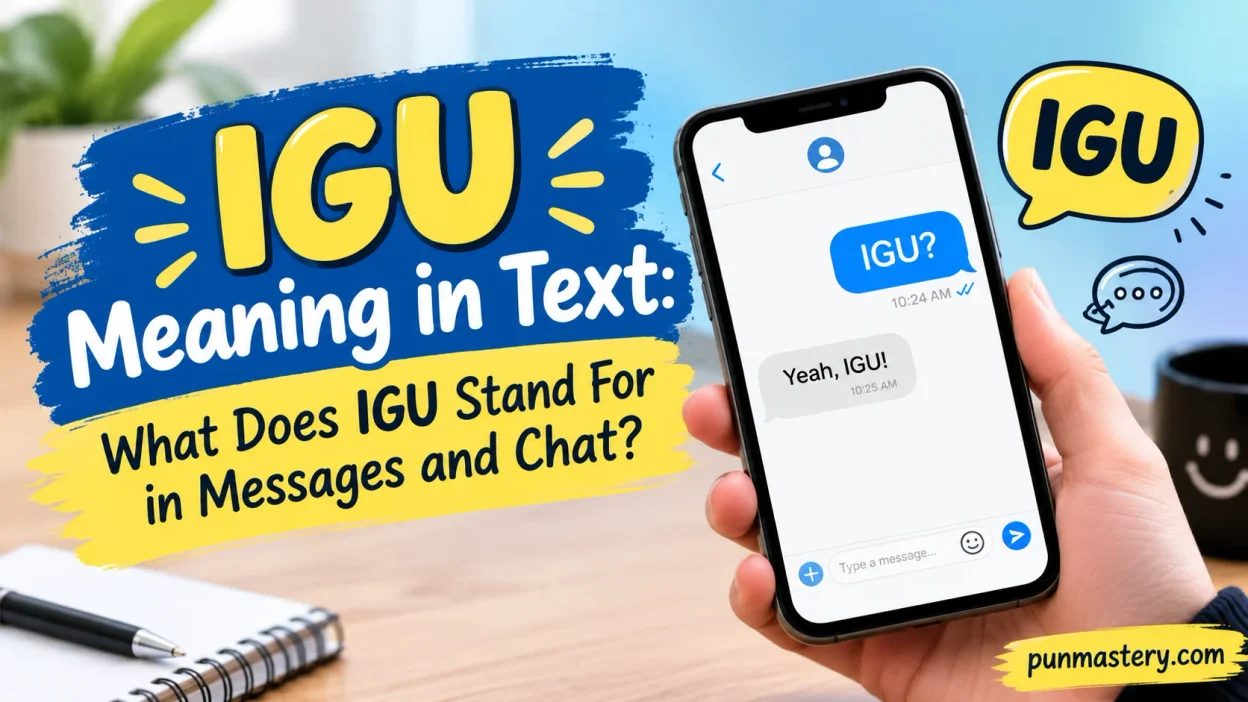
Discover IGU Meaning in Text and learn what this popular abbreviation means in chats, social media, and everyday conversations with examples.
Have you ever received a text that simply says “IGU” and wondered what the sender meant? You’re not alone. Texting abbreviations can make online conversations faster, but they can also leave you guessing when you don’t recognize them. The IGU meaning in text is commonly interpreted as “I got you.” Depending on the conversation, it can express understanding, offer help, acknowledge a request, or reassure someone that everything is under control.
For example, if you ask a friend to save you a seat and they reply “IGU,” they’re probably saying they’ll take care of it. However, abbreviations don’t always have one fixed meaning. The surrounding message, the relationship between the people chatting, and the subject of the conversation all help explain what IGU means. This guide covers its common meaning, real-life examples, social media usage, similar abbreviations, and the best ways to respond.
What Does IGU Mean in Texting?
In informal texting, IGU commonly stands for “I got you.” People use it as a short way to show that they understand something, agree to help, or will take care of a request.
Imagine that your friend texts you, “Can you remind me about the homework tonight?” You might reply, “IGU!” That short response communicates that you understand the request and intend to help.
The phrase can carry slightly different meanings depending on the situation. It doesn’t always mean that someone has physically received something or that they’ve completed a task.
Here are the most common ways people may use IGU:
- Offering help: Letting someone know you can help with a task.
- Showing understanding: Confirming that you understand what another person means.
- Providing reassurance: Telling someone they don’t need to worry because you’ll help.
- Acknowledging a request: Indicating that you’ve heard the request and will handle it.
- Showing support: Communicating that you’re available for someone when they need assistance.
For example:
Person A: “I’m nervous about presenting tomorrow.”
Person B: “Don’t worry. IGU.”
In this conversation, IGU may communicate support and reassurance. The exact meaning depends on what the two people have discussed.
It’s worth remembering that texting slang isn’t standardized. Although “I got you” is a plausible and common interpretation, the sender’s intended meaning should guide your understanding.
What Does IGU Stand For?
IGU represents the first letters of the words in the phrase “I Got You.” People shorten the phrase to make casual messages quicker to type.
The full expression has several conversational uses. To understand IGU properly, it helps to look at the different meanings of “I got you” in everyday English.
IGU as a Way to Offer Help
When someone says “I got you,” they may mean they’ll help with a task or take care of a request.
For example:
You: “Can you bring my notebook tomorrow?”
Friend: “IGU.”
The reply suggests that your friend understands what you need and intends to help.
IGU as a Sign of Understanding
Sometimes, “I got you” means “I understand what you’re saying.”
For example:
Person A: “Take the second street after the gas station, not the first one.”
Person B: “Okay, IGU.”
Here, the speaker confirms that they’ve understood the directions.
IGU as Reassurance
The phrase can also help someone feel supported during a stressful moment.
For example:
Person A: “I have so much to finish before Friday.”
Person B: “One thing at a time. IGU.”
The reply communicates a willingness to help or provide support.
IGU as an Acknowledgment
A person may use IGU simply to confirm that they’ve received and understood a request.
For example:
Person A: “Please text me when you arrive.”
Person B: “IGU!”
In this situation, the abbreviation functions as a quick acknowledgment.
Key takeaway: IGU usually works as informal conversational shorthand. Its precise meaning depends on whether the sender is offering help, confirming understanding, or reassuring someone.
How Is IGU Used in Text Messages?
The easiest way to understand IGU is to see how it fits into everyday conversations. Its meaning often becomes clear when you read the message that came before it.
When Someone Wants to Help
People may use IGU to tell friends or family members that they’re willing to help.
Example:
Alex: “Could you explain this math question to me later?”
Jordan: “Sure, IGU.”
Jordan is saying that they’ll help Alex understand the question. The abbreviation makes the response short and friendly.
When Someone Understands You
IGU can also confirm that someone understands an explanation, instruction, or personal concern.
Example:
Taylor: “I don’t want anyone sharing those pictures without asking me first.”
Morgan: “IGU. I’ll respect that.”
Here, Morgan communicates understanding. The additional sentence makes the intended meaning even clearer.
When Someone Offers Reassurance
Sometimes, a person uses IGU to let another person know they don’t have to handle everything alone.
Example:
Sam: “I’m worried I’ll forget everything for the school event.”
Riley: “I’ve got the checklist. IGU.”
Riley’s response suggests support and a willingness to help with the preparations.
When Someone Acknowledges a Request
IGU can serve as a brief confirmation when someone asks for a small favor.
Example:
Chris: “Can you save me a spot at lunch?”
Jamie: “IGU!”
The reply indicates that Jamie understands the request and intends to help.
When Someone Wants to Show Support
In some conversations, the phrase carries a sense of loyalty or encouragement.
Example:
Person A: “Today has been really difficult.”
Person B: “I’m here if you need anything. IGU.”
The full message communicates support more clearly than the abbreviation alone.
These examples illustrate possible uses rather than fixed rules. A short reply can mean different things depending on the messages around it.
IGU Meaning on Snapchat, Instagram, and Other Social Media Platforms
IGU isn’t limited to standard text messages. People may also use it in social media chats, comments, and direct messages. However, the platform itself doesn’t automatically determine what the abbreviation means.
IGU Meaning on Snapchat
On Snapchat, users often exchange brief messages while chatting with friends. An abbreviation such as IGU can fit naturally into these conversations.
For example:
Friend: “Can you send me the notes from class?”
You: “IGU.”
In this context, the reply likely means “I got you.” It indicates that you’re willing to send the notes or help with the request.
If someone sends IGU after you explain a problem, they may instead mean that they understand. Read the preceding messages to identify the intended meaning.
IGU Meaning on Instagram
On Instagram, IGU may appear in direct messages or casual conversations about plans, requests, and everyday activities.
For example:
You: “Can you let me know when the photos are ready?”
Friend: “IGU!”
The response suggests that your friend understands and will let you know.
An Instagram comment or direct message doesn’t give IGU a completely different meaning by itself. The topic and surrounding words matter more than the platform.
IGU Meaning on TikTok
People may use abbreviations in TikTok messages or conversations about videos, creators, and shared interests.
For example:
Person A: “Send me that video when you find it.”
Person B: “IGU.”
The reply likely means that the sender will help.
It’s best not to assume that IGU has a special TikTok definition unless the conversation provides evidence for one.
IGU Meaning in Online Games and Group Chats
In a gaming chat or group conversation, IGU may communicate that someone understands a plan or will help with a task.
For example:
Player A: “I’ll handle the first part. Can you cover the next one?”
Player B: “IGU.”
The response suggests understanding or agreement.
As always, the exact interpretation depends on the community and the conversation. Some groups may use abbreviations in their own ways.
Examples of IGU in Conversations
Looking at several examples can help you recognize the intended meaning more quickly.
| Text conversation | Likely meaning of IGU | Why it fits |
| “Can you bring my book tomorrow?” — “IGU!” | I got you | Acknowledges a request |
| “I’m confused about the instructions.” — “IGU.” | I got you | Offers understanding or help |
| “Please remind me about the appointment.” — “IGU.” | I got you | Indicates willingness to help |
| “I’m worried about tomorrow.” — “IGU. I’m here for you.” | I got you | Communicates reassurance |
| “Can you explain that again?” — “IGU.” | I got you | Signals understanding |
| “Save me a seat, please.” — “IGU!” | I got you | Confirms a small favor |
| “I need help organizing these files.” — “IGU.” | I got you | Offers assistance |
| “I’ll send you the details later.” — “IGU.” | I got you | Acknowledges the information |
These examples show why context matters. The same three letters can communicate agreement, understanding, or support without changing their basic interpretation.
A Simple Case Study: Understanding IGU Through Context
Consider three conversations involving the same abbreviation.
Situation A: A favor
- Message: “Can you pick up my notebook?”
- Reply: “IGU.”
- Likely interpretation: “I got you. I’ll help with that.”
Situation B: An explanation
- Message: “The meeting starts at nine, not ten.”
- Reply: “IGU.”
- Likely interpretation: “I understand.”
Situation C: Emotional support
- Message: “I’m having a rough day.”
- Reply: “IGU. Want to talk?”
- Likely interpretation: “I’m here to support you.”
The abbreviation stays the same, but the conversational purpose changes. This is a useful reminder that context often matters more than the abbreviation itself.
Is IGU Slang, an Acronym, or an Abbreviation?
IGU is informal texting shorthand when people use it to represent “I Got You.” More specifically, it can be described as an initialism-style abbreviation because each letter represents the beginning of a word.
An initialism is generally pronounced by saying its letters separately. However, people may read IGU as shorthand for the full phrase rather than pronounce each letter aloud.
In everyday digital communication, people often shorten familiar phrases to save time. Other examples include:
- IDK: I Don’t Know
- IKR: I Know, Right?
- IMO: In My Opinion
- BRB: Be Right Back
- WBU: What About You?
These abbreviations serve different purposes, but they share one practical benefit: they let people communicate quickly in informal settings.
IGU is best suited to casual conversations where the recipient understands the intended meaning. In a formal email, business report, or school assignment, writing the complete phrase is usually clearer.
For instance, “I understand and will take care of it” communicates more precisely in a professional message than “IGU.”
Is IGU Positive, Negative, or Flirty?
The abbreviation IGU is not inherently positive, negative, or romantic. Its tone depends on the conversation, the relationship between the people involved, and the words surrounding it.
Is IGU a Positive Expression?
IGU often has a positive or supportive tone when it means “I got you.”
Someone might use it to offer help, acknowledge a request, or reassure a friend. For example:
You: “I’m struggling to finish this project.”
Friend: “IGU. Let’s work through it together.”
The full response sounds supportive because it offers practical help.
However, the abbreviation alone doesn’t guarantee that someone feels strongly about the situation. It may simply be a quick acknowledgment.
Can IGU Be Flirty?
IGU isn’t inherently flirtatious. People can use it with friends, relatives, classmates, teammates, or romantic interests.
For example:
Person A: “You always remember the little things.”
Person B: “IGU 😊”
The reply might feel affectionate within that conversation, but the abbreviation itself doesn’t prove romantic interest.
If you’re trying to understand someone’s intentions, consider their overall communication rather than drawing conclusions from three letters. Their words, consistency, and the broader relationship provide more useful context.
Can IGU Sound Rude or Dismissive?
IGU doesn’t normally carry a rude meaning on its own. Still, short messages can sometimes seem abrupt when the conversation calls for a more thoughtful response.
For example:
Person A: “I’ve been upset about what happened today.”
Person B: “IGU.”
The sender may genuinely mean “I got you,” but the recipient might want more reassurance or a fuller reply.
A more supportive response could be, “I understand. Do you want to talk about it?”
The lesson is simple: don’t judge tone from the abbreviation alone. Consider the situation and the complete message.
IGU vs. Similar Texting Abbreviations
Several texting abbreviations look similar or express related ideas. Understanding their differences helps you choose the right interpretation.
| Abbreviation | Full form | Meaning in conversation |
| IGU | I Got You | Shows understanding, support, or willingness to help |
| IGT | I Got This | Suggests confidence in handling something |
| IKR | I Know, Right? | Expresses agreement or shared understanding |
| IDK | I Don’t Know | Expresses uncertainty |
| IMO | In My Opinion | Introduces a personal view |
| WBU | What About You? | Asks about another person’s view or situation |
| ILY | I Love You | Expresses affection |
| BRB | Be Right Back | Indicates a short absence |
IGU vs. IGT
IGU commonly means “I got you,” while IGT can mean “I got this.”
The difference is subtle but important.
- IGU: “You need help? I’ve got you.”
- IGT: “Don’t worry. I’ve got this.”
IGU often focuses on helping or understanding another person. IGT usually emphasizes the speaker’s ability to handle something themselves.
IGU vs. IKR
IKR means “I know, right?” People use it to agree enthusiastically with another person’s statement.
For example:
Person A: “That movie was amazing.”
Person B: “IKR!”
IGU, by contrast, is more likely to communicate understanding, reassurance, or help.
IGU vs. IDK
IDK means “I don’t know.” It expresses uncertainty rather than reassurance.
Compare these examples:
- “Can you help me with the assignment?” — “IGU.”
- “What’s the answer to question five?” — “IDK.”
The first response suggests willingness to help. The second indicates that the sender doesn’t know the answer.
IGU vs. ILY
ILY means “I love you.” It directly expresses affection, although the precise tone depends on the relationship and context.
IGU doesn’t have that same direct romantic or affectionate meaning. While it can sound caring in a particular conversation, it usually communicates support or understanding rather than love.
How to Reply When Someone Texts IGU
Your response depends on what the other person means and what you want to communicate. In many situations, a simple thank-you is enough.
Friendly Replies to IGU
If someone offers help or reassurance, you can respond warmly.
- “Thank you! I appreciate it.”
- “That’s really helpful.”
- “Thanks for being there.”
- “I appreciate you!”
- “You’re the best.”
These responses work well when the sender is doing you a favor or offering support.
Casual Replies to IGU
For everyday conversations, keep your response short and natural.
- “Sounds good!”
- “Awesome, thanks.”
- “Perfect!”
- “Great, appreciate it.”
- “Okay, thanks!”
You don’t need to use another abbreviation just because the other person did. Choose words that feel natural to you.
Replies When You Need Clarification
Sometimes, you may not know whether the sender is agreeing, offering help, or simply acknowledging your message.
In that case, ask a brief follow-up.
- “Thanks! Just checking, can you help me with it?”
- “Do you mean you understand?”
- “Okay, so you’ll take care of it?”
- “Thanks! What do you mean by IGU here?”
Asking for clarification is especially useful when the message concerns an important plan or responsibility.
How to Respond When IGU Offers Emotional Support
If someone uses IGU to show that they’re there for you, you can acknowledge the support without making the conversation complicated.
For example:
Friend: “Don’t worry. IGU.”
You: “Thanks. That means a lot.”
A genuine response usually works better than trying to find the perfect slang expression.
When Should You Use IGU?
IGU can be useful when you want to communicate quickly in an informal setting. Still, it isn’t the best choice for every message.
Appropriate Situations for IGU
You can generally use IGU when:
- Texting friends or family members who understand the abbreviation.
- Responding to a casual request.
- Chatting with people who regularly use texting shorthand.
- Acknowledging a message where the intended meaning is obvious.
- Offering brief reassurance in an informal conversation.
For example, replying “IGU” when a friend asks you to save a seat may feel perfectly natural.
When to Avoid IGU
Consider writing the complete phrase when:
- Sending a formal email.
- Communicating with a teacher, employer, or unfamiliar person.
- Discussing an important task or deadline.
- Giving instructions that need to be understood clearly.
- Messaging someone who may not recognize texting slang.
Instead of writing “IGU” in a work-related message, you could say, “Understood. I’ll take care of it.”
That version makes your intention clearer and sounds more professional.
Should You Write IGU in Uppercase or Lowercase?
People may write the abbreviation as IGU, igu, or sometimes Igu. Capitalization doesn’t necessarily change the intended meaning.
The choice usually comes down to personal typing habits. In a casual conversation, either uppercase or lowercase may be understood if the context is clear.
However, uppercase IGU makes the abbreviation easier to recognize in an article explaining its meaning.
Does IGU Have Other Meanings?
Yes. Like many abbreviations, IGU can mean different things in different fields.
In casual texting, “I Got You” is a plausible and common interpretation. Outside informal communication, however, IGU can refer to a technical term or an organization-specific abbreviation.
One established technical meaning is insulated glass unit.
An insulated glass unit is a window assembly made from two or more panes of glass separated by a sealed space. The design helps improve insulation compared with a single pane of glass.
You may encounter this meaning in discussions about:
- Window manufacturing.
- Building construction.
- Energy-efficient windows.
- Glazing systems.
- Home renovation and commercial buildings.
For example, a construction professional might write, “The IGU needs replacing.” In that sentence, IGU refers to an insulated glass unit rather than “I got you.”
This distinction shows why context matters. If someone uses IGU while discussing a favor, the texting interpretation may fit. If the conversation concerns window repairs, the technical definition makes more sense.
A useful rule: Identify the topic before deciding what an abbreviation means. The same group of letters can represent unrelated terms in different settings.
Common Misunderstandings About IGU Meaning in Text
Even when an abbreviation has a familiar interpretation, it’s easy to misunderstand it. A few simple checks can help.
Assuming IGU Always Means the Same Thing
IGU can mean “I got you” in casual messages, but that interpretation doesn’t fit every situation.
What to do: Read the surrounding conversation and consider the topic.
Assuming IGU Always Means Romantic Interest
A supportive message isn’t automatically flirtatious. Friends use reassuring expressions all the time.
What to do: Look at the broader relationship and the person’s communication rather than relying on one abbreviation.
Treating IGU as a Promise That Everything Is Done
When someone writes IGU, they may be agreeing to help or acknowledging a request. That doesn’t always mean they’ve completed the task.
What to do: If the task matters, confirm the details. For example, ask, “Thanks! Can you send it by this afternoon?”
Confusing IGU With IGT
The two abbreviations may look similar, but they often communicate different ideas.
What to do: Remember that IGU commonly emphasizes helping or understanding someone, while IGT often means the speaker can handle something themselves.
Assuming Every Social Media Platform Gives IGU a Unique Meaning
An abbreviation may appear on different platforms without changing its meaning.
What to do: Focus on the conversation itself rather than assuming that Snapchat, Instagram, or TikTok automatically changes the definition.
FAQs
What Does IGU Mean in a Text Message?
IGU commonly means “I got you” in informal text messages. People may use it to show understanding, offer help, acknowledge a request, or reassure someone. The exact interpretation depends on the surrounding conversation.
Does IGU Mean “I Got You”?
Yes, that is a common interpretation of IGU in casual texting. For example, if you ask a friend to save you a seat and they reply “IGU,” they likely mean they’ll take care of it. However, context still matters.
What Does IGU Mean on Snapchat?
On Snapchat, IGU can mean “I got you,” just as it can in other informal conversations. Someone might use it to agree to help, confirm understanding, or acknowledge a request. The preceding messages usually provide the best clue.
Is IGU the Same as I Got This?
No, the phrases generally communicate different ideas. IGU commonly stands for “I got you,” which can express support or willingness to help. IGT may stand for “I got this,” which usually expresses confidence that the speaker can handle something.
Is IGU Appropriate for Professional Messages?
IGU is usually better suited to informal communication. In professional emails or messages involving important tasks, write the full phrase or explain exactly what you’ll do. For example, “Understood. I’ll send the document by noon” is clearer than “IGU.”
How Can I Tell What IGU Means in a Conversation?
Read the messages before and after IGU. If someone has asked for a favor, the abbreviation may signal willingness to help. If they’ve explained something, it may mean they understand. When the meaning remains unclear, ask the sender directly.
Can IGU Have a Meaning Outside Texting?
Yes. In construction and window manufacturing, IGU can stand for insulated glass unit. This refers to a window assembly containing multiple panes of glass separated by a sealed space. The subject of the conversation helps distinguish the technical meaning from the texting abbreviation.
Conclusion
The IGU meaning in text is commonly understood as “I got you.” In everyday digital conversations, it can communicate understanding, willingness to help, acknowledgment, or reassurance. You may see IGU in text messages, Snapchat chats, Instagram direct messages, and other informal online conversations. Although the platform can provide context, the surrounding words are usually more important than where the abbreviation appears.
Remember that IGU doesn’t automatically indicate romantic interest, guarantee that a task is complete, or carry exactly the same meaning in every situation. In technical discussions, it can even stand for something entirely different, such as an insulated glass unit. When you receive IGU in a message, read the conversation as a whole. If the meaning still isn’t clear, a quick question can prevent confusion and keep the conversation moving naturally.